Showing posts with label French. Show all posts

Sunday, January 8, 2012

Vous avez voté ? Maintenant ne vous souciez de rien, le palais s'occupe du reste...

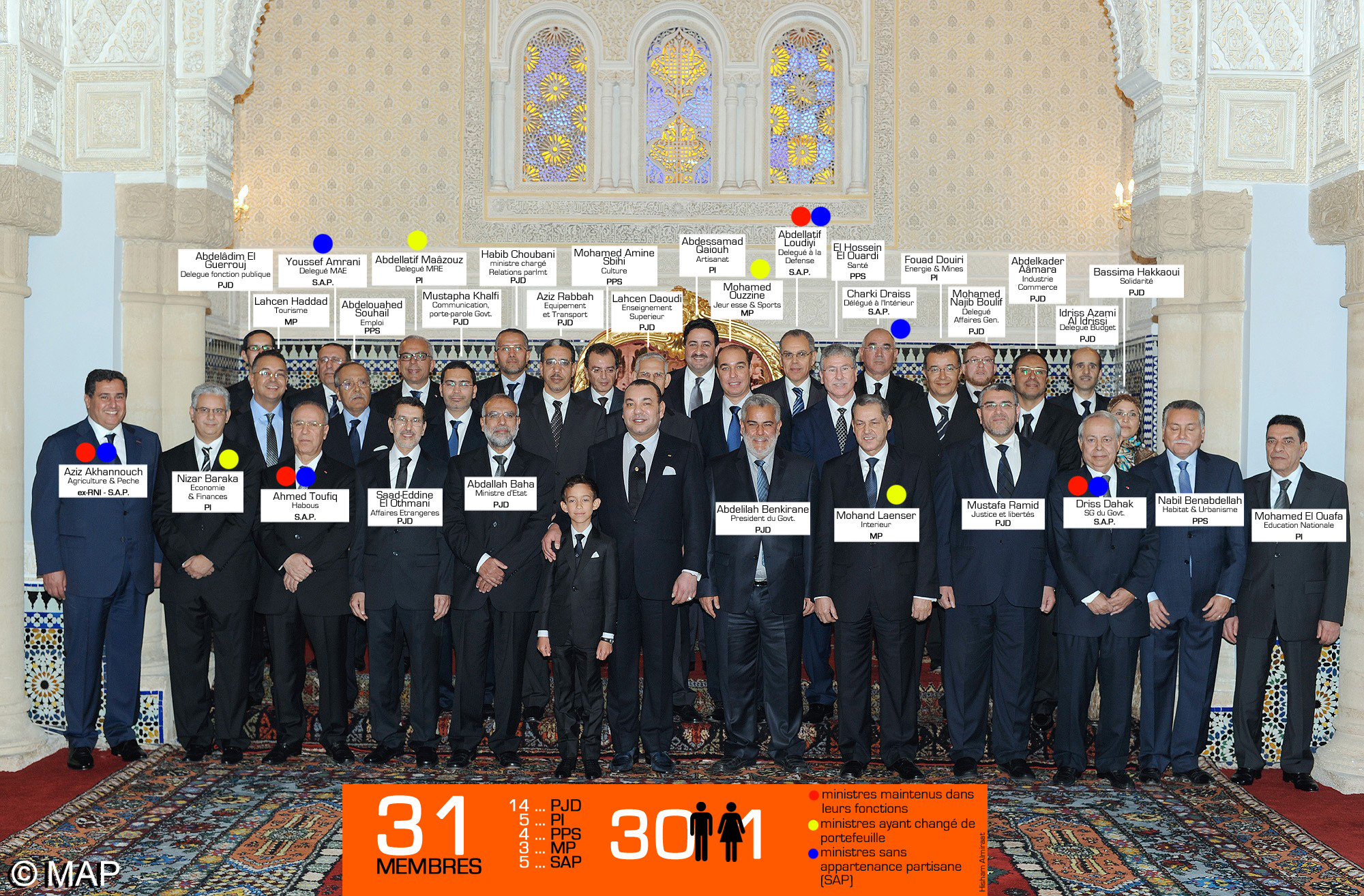
Intéressant article signé par la très sérieuse Associated Press dans lequel on peut lire une déclaration de Abdellah Baha qui reconnaît que le retard accusé lors des tractations pour former le gouvernement était dû aux réticences du palais quant à la nomination de Ramid au ministère de la justice.

Aboubakr Jamai y est également cité. Il considère que les concessions du PJD constituent une défaite pour les islamistes : "C'est une défaite majeure pour le PJD; c'est au moins le signe qu'ils ne prennent pas sérieux la nécessite de faire face aux réels problèmes de ce gouvernement."

L'article ne mentionne pas l'autre niveau de contrôle que constituent les "conseillers" du roi qui, s'ajoutant aux ministres délègues et autre Secrétaire Général du gouvernement, forment un système à double verrou ou le PJD sera gardé bien en laisse.

Les gens qui ont voté, ne se sentent ils pas trahis ? Non ? Même pas un chouia ? Walou ?

Friday, January 6, 2012

[Infographie] Gouvernement Benkirane : rémunérations et indemnités - #Maroc

Un article paru dans Lakome.com aujourd'hui détaille les rémunérations et indemnités des membres du gouvernement Benkirane. Infographie (cliquez pour agrandir) :


Ramid veut reformer la Justice... mais "c'est au roi de prendre la décision"

Mustapha Ramid est probablement le plus en vue des ministres du parti islamiste PJD, depuis qu'il a été nommé à la tête d'un des ministères clés du gouvernement marocain, celui de la Justice (et des libertés publiques, faut-il le préciser ?). Il s'est distingué dans le passé par son franc parler et ses positions clairement opposées aux pratiques du Makhzen, le pouvoir marocain. Dans une interview qu'il a accordée mardi à Reuters, le nouveau ministre déclare vouloir mettre fin aux pratiques du passé, notamment en ce qui concerne le code de la presse et le cas des nombreux prisonniers d'opinion, pour lesquels il laisse entendre qu'il demandera la grâce royale :
"Nous avons notre vision des choses mais nous avons également des contraintes institutionnelles. Le gouvernement ne peut pas intervenir dans la justice. C'est une institution indépendante.

"Il y a cependant une voie unique, qui est celle du pardon royal. Nous y travaillerons donc et nous déploierons nos efforts pour essayer de régler ce problème. En fin de compte, ce n'est pas à nous de décider mais c'est au roi de prendre la décision. Nous essaierons de faire en sorte que cette décision soit basée sur des informations et des propositions que nous présenterons (au roi)."

Friday, December 2, 2011

Ceci n'est pas un changement


L'idée du poster ci-dessous m'est venue suite à une discussion avec un ami où il était question du mouvement du 20 février. La question était de savoir si ce dernier avait joué un role dans l'évolution que connaît le Maroc actuellement. Dans mon esprit la réponse est claire : sans le mouvement du 20 février, il est très probable qu'aucune des réformes n'aurait été initiées. Mais le poster mérite une courte explication. Je n'ai pas envie de m'étaler en prose, alors je dirais que ce n'est pas une tentative de minimiser la victoire du PJD, qui est par ailleurs méritée. Cette victoire soulève cependant autant de questions qu'elle ne suscite d'espoir. Je suis sceptique à l'idée que le Makhzen se soit définitivement retiré des affaires mais j'espère me tromper. Que ceux qui gouverneront ce pays tiennent tête aux injonctions autoritaristes du régime. Mais surtout que ceux qui prétendent être démocrates reconnaissent au mouvement du 20 février son droit à manifester et son rôle dans cette évolution--aussi incomplète et frustrante soit elle--au lieu de lui jeter des pierres.

Thursday, December 1, 2011

Infographie des législatives marocaines par Chihab Semlali

Brillante infographie réalisée par M. Chihab Semlali (@chihabsemlali) sur les résultats des législatives du 25 novembre, même si j'ai quelques réserves sur l'interprétation qui est faite des idéologies des principaux partis.

Monday, August 16, 2010

On Promoting English As a Second Language In Morocco

Drawing on an article by Nabila Taj published yesterday on Global Voices who was reporting on comments by some Moroccan bloggers and writers who are calling for an outright departure from French language in Morocco, and its replacement by English as a second language, I'd like to add my own perspective on that very important debate for Morocco indeed.

Morocco has been independent for nearly 55 years now, yet French influence is still plainly seen, heard, perceived in almost every walk of life in the country. France is actively promoting the use of its language in Morocco, if only for the enormous economic benefits its business can reap. Blaming France for that would be disingenuous of course, but the almost exclusive adoption of French in business, education, research (insofar as the latter exists) in today's globalized world, is dramatically absurd and a strategic blunder for the country's future. Whilst the world is talking in English (or Globish as some like to call it) and increasingly in Mandarin, in Morocco we're happy to keep ourselves culturally and economically subjected to one single economy and culture that some, arguably, claim is in decline (that's what the French themselves think anyway [Fr]).

Had the exclusive adoption of the French language in education, research, business, undergone the meticulous test of public and democratic scrutiny, there would have been more than one reason to ditch it in favor of English and maybe also other languages. Unconvinced? Take a look at these comments:
The Pittsburgh Post-Gazette -June 2010

[in Pittsburgh, USA,] study found that percentages of enrollment growth for [French and German] from 2002 to 2006 was in the single digits, compared to double-digit growth for Chinese and Spanish and triple-digit growth for Arabic.
[...]
These days, neither French nor German is considered central to the modern American's life or sensibility, says John McWhorter, a linguist and contributing editor at The Manhattan Institute, a New York City think tank.

"The emphasis on French learning back in the day was based on a logical desire to teach people a language that most foreigners they were likely to meet could speak," he said. "Today knowing some French is one part a marker of middle-class propriety and one part a key to reading 'Madame Bovary.' "

Daily Mail Online - June 2010

A former Foreign Office minister has branded French a 'useless' modern language.
Chris Bryant, now a shadow Foreign Office minister, told the Commons other languages - such as Mandarin, Spanish, Portuguese, and Arabic - were more important.


Associated Press - June 2010

Language instructors say the rapidly growing Chinese economy is causing French language classes to be phased out and replaced with Mandarin Chinese classes in private and public schools.
[...]
[S]urvey in 2006 showing enrollment in French between 1990 and 2006 was down by 43%. Chinese was up 106%.


Actually I don't think it would be wise to phase out French (or Spanish for that matter) completely, and I am not in the business of disparaging France here, but rather calling for a more informed choice based on the best of interests for the country.

Apart from the big picture and the silly restrictions that Morocco imposes on itself as far as dealing with the rest of the world is concerned, the exclusive adoption of the French language in the judiciary or in higher education for example has some perverse local implications that sometimes defy common sense. Moroccan blogger and lawyer Ibn Kafka touches upon [Fr] the implications of the systematic copycat of French laws that are transfered (or only rarely edited) and adopted as Moroccan Law, "exactly as if Morocco were a French territory" says the blogger.

I studied medicine in Casablanca entirely in French. I remember my first medical consultation pretty well. Most patients we treated were poor, mostly illiterate, speaking exclusively Arabic or Berber, little French or no French at all. Symptoms upon which we were supposed to base our diagnosis were usually described in vernacular Moroccan Arabic. Each time we finally happily made a diagnosis we had to go to great lengths to explain what we thought the patient was suffering from. Our courses of Anatomy, Physiology, Pathology... were unedited copies of French courses. Even when professors had to back their words with statistics they invariably came up with French epidemiological figures. It was really (and continues to be) a surreal environment where we knowingly learned things that dind't match reality. What we learned served primarily to pass exams. Once in the real world, it was a completely different story.

More and more Moroccans are now asking for a revival of the Arabic language (not without controversy - read this interesting work on that subject from The Ontario Institute for Studies in Education) in higher education in particular and for the promotion of English.

A group on Facebook unambiguously called Moroccans For English counts more than 1,600 members. The group describes itself in these terms:


This group aims to gather all Moroccans and friends of Morocco who share the same desire of seeing Morocco finally hop into the train of modernization and globalization by means of acquiring the number one spoken language in the world.
It is the language of finance and business, diplomacy, science and technology, showbiz and any other important sector.
[...]
For decades, Morocco has been missing out on this important factor of success in this modern world. The few lucky ones who realized the opportunity have seen doors of endless possibilities open before their eyes. The majority of us stayed behind, cut from the rest of the world, happy to converse and do business with our closest neighbours only. We waited tirelessly and repeatedly for French translations of new inventions, technology, reports, movies and so on.


Whilst the desire to emancipate from former colonial France is real and powerful, it is important to remember that learning English in itself is certainly not sufficient to open the doors for foreign investment and prosperity for the country. Indeed some of the poorest countries on earth do speak English almost as a first language. I do believe Moroccans can make their knowledge and mastery of the French language an asset rather than a liability. Rather than looking at English and French as exclusive to each other we should be trying to get the best of the two worlds.