Sunday, August 31, 2014
Sunday, August 4, 2013
طاحت الصمعة، علقو الحجام٠٠
Monday, November 5, 2012
#Maroc: La société civile dénonce la faillite de la politique migratoire européenne
Des membres de la société civile marocaine ainsi que nombre d'organismes de défense des droits humains publient une lettre ouverte à l'adresse de l'Union européenne aujourd'hui dans le but de dénoncer sa politique migratoire sur la rive sud de la méditerranée, dont voici le texte intégral :
http://openlettereu.blogspot.com/p/lunion-europeenne-que-vous-representez.html
Wednesday, August 22, 2012
Pour le Makhzen, un bon marocain est un marocain soumis
J'ai suivi avec attention cet après midi les nouvelles de la manifestation pour laquelle de courageux et intègres compatriotes ont appelé aujourd'hui. Une "fête d'allégeance pour la dignité et la liberté" l'avaient ils appelée. Elle devait se dérouler devant le parlement. Un pied-de-nez a cette humiliante cérémonie d'allégeance au roi Mohammed VI, orgie de servilité, a laquelle se sont adonnés les dignitaires du régime hier.
Sunday, February 5, 2012
تازة : حكومة البومبية كتلعب بالنار
حركوا هواتفكم وجيوبكم وأعصاب الإبداع في أذمغتكم؛ "إنهم يُعممون القمع، لنعمم التضامن" !
Sunday, January 8, 2012
Vous avez voté ? Maintenant ne vous souciez de rien, le palais s'occupe du reste...
Aboubakr Jamai y est également cité. Il considère que les concessions du PJD constituent une défaite pour les islamistes : "C'est une défaite majeure pour le PJD; c'est au moins le signe qu'ils ne prennent pas sérieux la nécessite de faire face aux réels problèmes de ce gouvernement."
L'article ne mentionne pas l'autre niveau de contrôle que constituent les "conseillers" du roi qui, s'ajoutant aux ministres délègues et autre Secrétaire Général du gouvernement, forment un système à double verrou ou le PJD sera gardé bien en laisse.
Les gens qui ont voté, ne se sentent ils pas trahis ? Non ? Même pas un chouia ? Walou ?
Friday, January 6, 2012
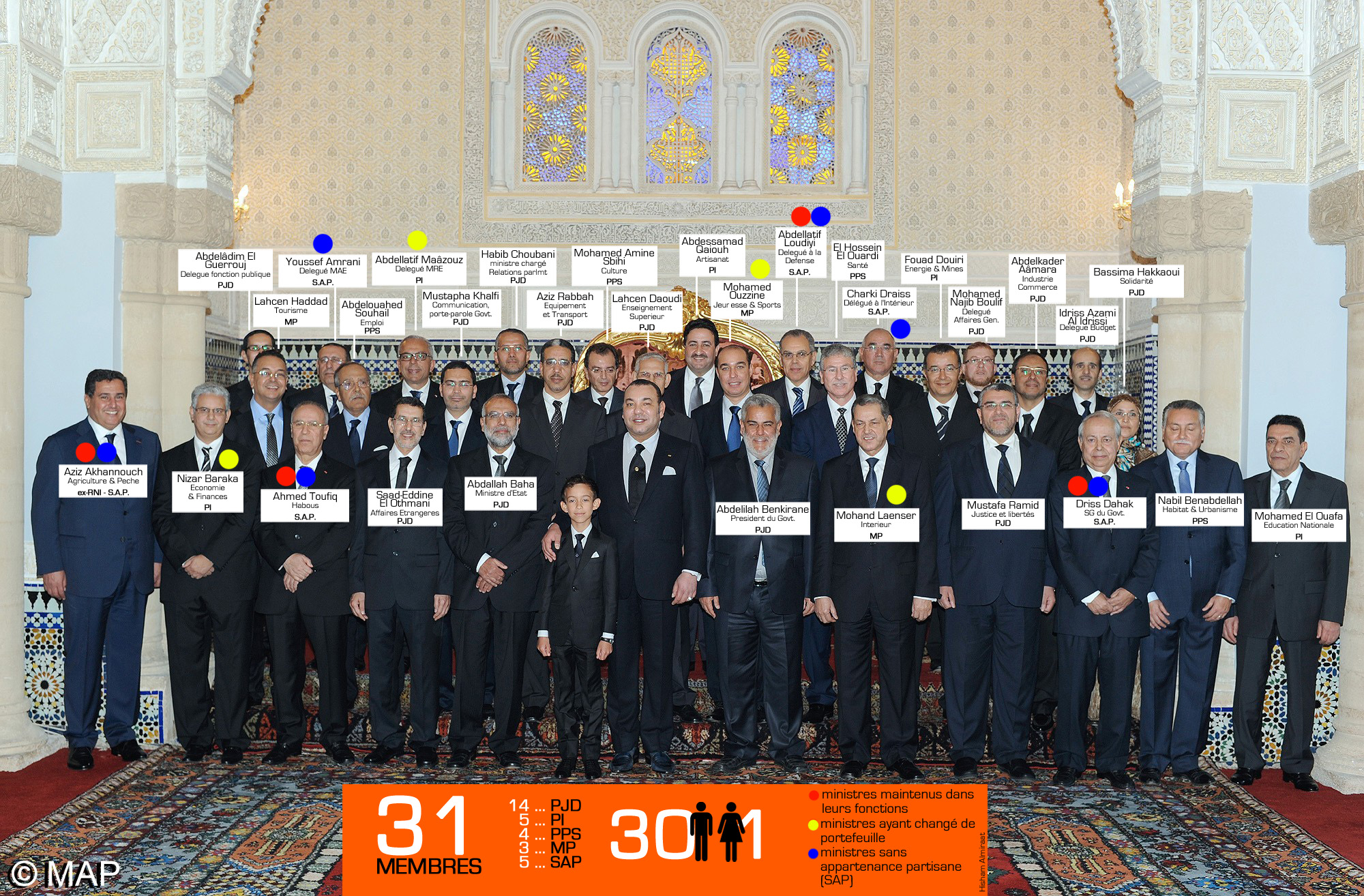
[Infographie] Gouvernement Benkirane : rémunérations et indemnités - #Maroc
Ramid veut reformer la Justice... mais "c'est au roi de prendre la décision"
"Nous avons notre vision des choses mais nous avons également des contraintes institutionnelles. Le gouvernement ne peut pas intervenir dans la justice. C'est une institution indépendante.
"Il y a cependant une voie unique, qui est celle du pardon royal. Nous y travaillerons donc et nous déploierons nos efforts pour essayer de régler ce problème. En fin de compte, ce n'est pas à nous de décider mais c'est au roi de prendre la décision. Nous essaierons de faire en sorte que cette décision soit basée sur des informations et des propositions que nous présenterons (au roi)."
Monday, December 5, 2011
Free Razan!
Razan is an indefatigable campaigner for human rights and freedom of expression in her country. She has been advocating for the rights of political prisoners and minorities in Syria and has always fought for the rights of the Palestinians. She is one of the few Syrian bloggers who writes under her real name.
Razan is the most driven, thoughtful and freedom loving person I have ever met. Tonight I'm really worried about my friend and I ask for her immediate release. Please join the #FreeRazan campaign by spreading the word and showing support.
Please find pictures on the following link that you can use on your blogs or as avatars or as Facebook profile pix http://t.co/3tjhQo3y
Resources:
- Activists: US-born Syrian blogger arrested - AP
- Syria: Free Razan Ghazzawi - Global Voices
- Syrie : Libérez Razan Ghazzawi ! · Global Voices
- #FreeRazan campaign Facebook group.
- Twitter: Follow the hashtag #FreeRazan.
Friday, December 2, 2011
Ceci n'est pas un changement
L'idée du poster ci-dessous m'est venue suite à une discussion avec un ami où il était question du mouvement du 20 février. La question était de savoir si ce dernier avait joué un role dans l'évolution que connaît le Maroc actuellement. Dans mon esprit la réponse est claire : sans le mouvement du 20 février, il est très probable qu'aucune des réformes n'aurait été initiées. Mais le poster mérite une courte explication. Je n'ai pas envie de m'étaler en prose, alors je dirais que ce n'est pas une tentative de minimiser la victoire du PJD, qui est par ailleurs méritée. Cette victoire soulève cependant autant de questions qu'elle ne suscite d'espoir. Je suis sceptique à l'idée que le Makhzen se soit définitivement retiré des affaires mais j'espère me tromper. Que ceux qui gouverneront ce pays tiennent tête aux injonctions autoritaristes du régime. Mais surtout que ceux qui prétendent être démocrates reconnaissent au mouvement du 20 février son droit à manifester et son rôle dans cette évolution--aussi incomplète et frustrante soit elle--au lieu de lui jeter des pierres.
Thursday, December 1, 2011
Infographie des législatives marocaines par Chihab Semlali
Required reading: Morocco's new elections, just like the old elections?
On Foreign Policy Daphne McCurdy, who participated in an international observation mission for Morocco's November 25 elections, goes beyond the clichés surrounding the victory of the Islamist PJD party and describes fairly accurately the political reality in the country and the issues at hand following that crucial poll. Truly, the most well-informed and thoughtful article I read so far about the recent legislative elections.
Both the low turnout and the PJD's success show that Moroccans want genuine change, and won't be fooled by superficial attempts to win them over. But it is clear that such meaningful change will not come from the king. With endemic corruption, decreasing quality of health care and housing, and increasing levels of unemployment, Moroccans suffer from the same issues that ail the rest of the Arab world. While they probably don't want to go down the path of revolution, unless political parties take more ownership of the political process and stand up to the king, disaffected Moroccans may find they have nowhere to go but the streets.
Read more...
Friday, November 25, 2011
Morocco: Why do I boycott? | openDemocracy
On November 25, 2011, Moroccans will vote in theirfirst parliamentary election since a referendum approved a series of constitutional amendments. The amendments, introduced by the king, are intended to reduce the monarch’s prerogatives in favour of an elected legislative body. However, for myself and a number of Moroccan democrats, there exist many reasons why we choose to respond to the call of theFebruary 20 movement and why we will boycott the upcoming election.
Wednesday, November 23, 2011
Legislatives marocaines : Je boycotte... et voici mes raisons
Je voudrais m'adresser a mes compatriotes honnêtes et bien intentionnés qui veulent aller voter aux législatives vendredi et ceux qui hésitent encore à prendre la décision de sortir voter le 25. Je parle à ceux qui pensent, en leur âme et conscience, qu'en allant voter ils pourront aider au changement en apportant du sang neuf aux institutions, en espérant ainsi pousser la classe politique actuelle, majoritairement corrompue et inféodée au Makhzen, en dehors du système.
J'aimerais partager avec eux mon point de vue et leur expliquer pourquoi je suis convaincu que le boycott et le meilleur choix à faire. Avant qu'ils ne s'énervent et qu'ils ne cliquent sur la petite croix, je leur demanderais de me donner une petite chance en lisant ce qui suit.
Je suis intimement convaincu que les personnes bien intentionnées qu'elles sont espèrent voir une transition démocratique au Maroc sans faire courir au pays les risques de crises internes ou de conflits que d'autres pays de la région connaissent.
Mais dans les conditions politiques actuelles dans lesquels se retrouve le Maroc, voter consisterait à essayer de traiter un cancer à coup de tablettes de paracetamol.
Je les invite maintenant à laisser libre cours à leur imagination. Essayons ensemble de dessiner les trajectoires hypothétiques, mais réalistes de ce processus en cours. Qu'arrivera t-il si 1) le taux de participation est élevé, et si 2) à l'opposé, le taux d'abstention est plus conséquent.
Sunday, November 6, 2011
Morocco: Coalition Warns of "Serious Risks" if Parliamentary Monarchy Not Implemented Fully
The Coalition For a Parliamentary Monarchy Now is a Moroccan group close to the youth-based pro-democracy movement February 20. It was founded back in June and has been campaigning for the immediate implementation of a parliamentary monarchy in Morocco--Not without controversy within the pro-democracy camp which is made of an eclectic and broad coalition of political activists and militants ranging from republicans in the left to monarchists in the right and comprising various breeds of Islamist and secularist militants.
The Coalition For a Parliamentary Monarchy Now thinks a parliamentary monarchy is "the only effective way to combine monarchy and democracy." It has been critical of the reforms conducted by the king earlier this year. In a press release published today [in Arabic... English translation to follow hopefully soon] it is urging the Moroccan power "to repeal the current constitution, ensure healthy electoral competition between parties--not only between the notables, promote transparency, accountability and put en end to years of impunity."
Tuesday, September 6, 2011
Morocco: Pro-Democracy Movement Calls for a Day of Protests on Sept. 11
[youtube http://www.youtube.com/watch?v=-e19zfRzC14&w=520&h=345]
Generation 9/11: Ten Years On
Today, the British council is launching a video campaign called "Generation 9/11." The project is seeking to capture the views of people online in an effort to use the anniversary of the attacks of 9/11 to move the dialogue on Muslim – Non-Muslim relations forward.
The first batch of videos was sent from contributors in the U.S., Pakistan, Egypt, Morocco and Hungary:
You can watch my contribution here. Your comments are more than welcome.
You can watch the latest updates by following these links:
[vimeo http://www.vimeo.com/28574440 w=400&h=300]
Generation 9/11: Salmaa Elshanshory (USA)
[vimeo http://www.vimeo.com/28304034 w=400&h=225]
Generation 9/11: Nadia Zaffar (Pakistan)
[vimeo http://www.vimeo.com/28271762 w=400&h=225]
Generation 9/11: Shawn Lent (USA)
[vimeo http://www.vimeo.com/28277268 w=400&h=225]
Generation 9/11: Hisham Almiraat (Morocco)
[vimeo http://www.vimeo.com/28287108 w=400&h=225]
Generation 9/11: Cristina Balli (USA)
[vimeo http://www.vimeo.com/28288332 w=400&h=300]
Generation 9/11: Naveed Ahmad (Pakistan)
[vimeo http://www.vimeo.com/28265065 w=400&h=225]
Generation 9/11: Krisztian Gal (Hungary)
[vimeo http://www.vimeo.com/28287241 w=400&h=300]
Saturday, September 3, 2011
Cabled!
Summarizing the mood, one blogger on Global Voices wrote, "The end of 'Le Journal' signals a dangerous setback for the state of freedoms in Morocco. It pulls a thorn out of the regime's side but it also sends a strong message to the remaining independent media still struggling to survive in an increasingly repressive environment."
The cable sent in February 2010 from the US embassy in Rabat is reporting on the closure of a prominent Moroccan independent weekly, Le Journal, which the cable describes (quite correctly) as "the vanguard of the Moroccan independent press, serving as a potent symbol of the new face of Morocco promoted tirelessly by King Mohammed VI."
The controversy around Wikileaks aside, the released diplomatic cables have revealed a general rule among American diplomats posted in the Arab world: they are mostly clueless about what was happening in the region, as demonstrated by a rather shallow cable on a meeting diplomats had with two prominent human rights activists in Morocco in 2009 for example.
But I must admit, this one piece of diplomatic correspondence sounded like it got it right. "When it's in line with their own values, they get it right" commented my friend Jillian York, with whom I agree. Take a read!